Mediating the Case You Have, Not the Case You Wish You Had

Lessons from the lawyer’s chair for the mediator’s chair
By Raymond L. Niblock

I recently represented a plaintiff in a personal-injury mediation that ultimately resolved with a substantial financial result for my client. But the result, though remarkable, is not what made the mediation memorable. What stayed with me was something much more useful because I had an imperfect plaintiff, an imperfect case, and a mediator who understood that reality testing does not require humiliation.
As a trial lawyer, I have spent decades practicing how to present cases to juries, but as my professional focus is shifting toward mediation, I have been learning more and more about how people make decisions amid conflict, uncertainty, fear, anger, and risk, rather than being solely focused on "winning."
In this mediation, those experiences came together. Even as the lawyer, I brought my mediation training and experience into the room. After all, I have taken clients through mediations, as well as jury trials, throughout my career. Countless mediations and dozens of jury trials by now. And yet when it was over, I left the room having learned things from the experience that I will carry into the next case in which I serve as mediator. That is the thing about this process. There is always something new to learn, and staying curious and humble are the keys to success in this business of "getting to yes."
The Case I Had
Every trial lawyer has experienced the temptation to mentally rewrite a case.
If only the medical record said this.
If only the witness had answered that question differently.
If only the deposition testimony had been cleaner.
If only the client had understood what the lawyer was trying to explain before answering.
If only.
But we do not mediate the case we wish we had. We mediate the case we actually have. In that way, it is just like a trial. And while my case had its strengths, it also had real problems. There was a significant liability question. Even getting over that left me with the specter of comparative fault that could not be defeated. All the arguments in the world would not prevent a judge from instructing a jury to consider it. Medical issues could be interpreted in more than one way, and the defense could exploit those issues to effectively attack damages, albeit at great cost - the defense would require at least two experts to tear down my client’s medical, but still, it could happen. My client’s testimony had problems. Some facts, viewed through one lens, supported our position and, viewed through another, could make a juror skeptical or flat-out disbelieve my client, who was not a sophisticated litigant.
He did not understand litigation the way lawyers do. But what civil plaintiff ever does? For most plaintiffs, the case they have will be their first, and statistically, their last. Even an “experienced” plaintiff, which my client was not, could not reasonably be expected to appreciate every medical distinction, evidentiary problem, inconsistency, impeachment point, or nuance of causation that lawyers on both sides had spent months studying.
And then there were the costs of proof. Experts. A legion of them would be required, and in this case, I could see $100,000 or more spent on experts at a trial that would, even then, present an uncertain outcome, no matter how much money we might spend. And that is not really my money to spend. It is my client’s.
Ultimately, any settlement decision belonged to the client, and that’s where mediation becomes something more than negotiating numbers.
The Brief Was Part of the Mediation
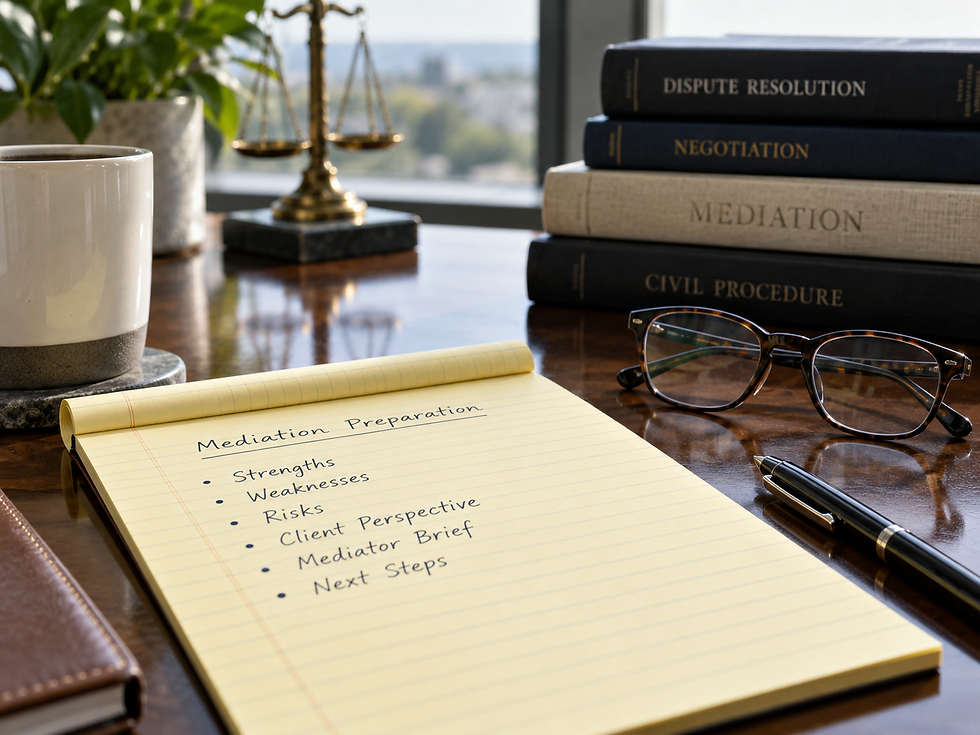
Before the mediation, I prepared a candid submission for the mediator. I did not simply tell him why we should win. I told him where I thought we could lose. That is a different kind of advocacy, and for a trial lawyer, it can feel a bit foreign. For example, most trial lawyers would agree that a mediation statement should advocate. But if the mediator is going to help the parties evaluate risk, the mediator needs more than a closing argument disguised as a confidential mediation statement. He needs the whole of the case, not bits and pieces. That means strengths, weaknesses, uncertainties, and the places where even counsel is uncomfortable. Why? Because that helps the mediator understand the risks and, in turn, sensitize the parties to the risks they face. It also helps eliminate surprises during mediation.
Acknowledging a weakness does not concede the case, at least not in the mediator’s frame of reference. No. What it does is give the mediator something useful to work with. And in this case, the mediator used it, and while doing so, there were very few surprises. That might have been the greatest utility in providing him with the statement I provided, because once I did, I went over the same statement with my client so my client would not be surprised or look at me with that look all clients develop in a case at one point or another. It is the “What the *^$% just happened” look. Every trial lawyer knows that look, and every trial lawyer wants to avoid it because it can begin eroding a client's confidence in the lawyer; if a client loses confidence, the lawyer’s advice will fall on deaf ears.
More Than Ferrying Numbers

There is a style of mediation that sometimes feels like shuttle diplomacy conducted with a calculator. One room makes a demand. The mediator walks down the hall. The other room makes an offer. The mediator walks back. Repeat until someone says yes, someone says no, or everyone goes home.
While plenty of numbers were exchanged, the main thing that happened here was not the exchange of numbers, but what the mediator did to get the parties in a position to exchange them. To get us ready, he listened. And then he listened some more.
He did not immediately reduce everything to a settlement range, though eventually, he did. But not at first. At first, he observed my client. He listened and studied the case. He learned what my client believed had happened to him, what the real driving force behind my client’s “why” was, what the defense believed the evidence showed, and where those two versions diverged. Most importantly, he found ways to describe difficult evidence without converting an evidentiary problem into a moral judgment about the person sitting in front of him.
That is a skill.
It is also an art, I think, but a skill for sure. And it is a skill that can be taught, practiced, and improved.
Some mediators may be “naturals,” but I am convinced the greatest ones understand that this kind of soft skill can always be sharpened through practice, reflection, and training.
There Is a Difference Between Credibility and Character
The defense could use some of the evidence and testimony to challenge my client’s credibility. That means raising a question mark in the jury’s mind.
The mediator could have handled that badly. He could have reduced the problem to: They think you’re lying. Or worse: A jury may think you’re lying.
Sometimes, direct language is necessary. But it can also shut a person down, particularly when the client does not understand why lawyers attach significance to particular answers, medical records, testing, or inconsistencies.
Instead, the mediator painted the picture. He explained how particular facts might look to people who did not know my client. He explained why the defense saw certain evidence differently than we did.
He explained that a jury would receive competing interpretations and that neither lawyer could guarantee which interpretation twelve strangers would accept. He talked about risk without assigning shame. And more importantly, he discussed risk without giving advice. He stayed in his lane.
The distinction mattered.
My client did not have to agree that the defense was right. Rather, he needed to understand that the defense had arguments a jury could accept. Those are very different propositions.
Reality Testing Is Not Beating Someone Down

One thing my experience as a trial lawyer and mediator has reinforced for me is the importance of reality testing. It can be a delicate issue, and in some cases it presents an ethical tightrope for the mediator. When does reality testing in an evaluative style of mediation begin to sound like advice? When does a party begin to perceive the neutral’s evaluation as advocacy for the other side? A party cannot make an informed decision without understanding the alternatives, and, most importantly, a party cannot make a reasoned decision without trusting the process and the mediator.
What happens if we do not settle?
What might happen at trial?
What evidence helps us?
What evidence hurts us?
How much uncertainty are we willing to accept?
What is the best realistic outcome?
What is the worst realistic outcome?
Those are difficult conversations, but reality testing should not become a contest to see whether the mediator can convince a party that his case is terrible, because the objective is not surrender. The objective is informed decision-making. It is taking something that is intensely personal and converting it into a reasoned business decision.
"How much can I sell a release of claim for, and if I keep the case and remit it to a jury, can I expect to do better?"
In this situation, the mediator questioned my client’s assumptions without undermining his dignity. Since my client didn’t feel threatened, he was able to listen. Occasionally, the mediator also challenged me. This was justified, but it was done in a manner that didn’t cause me to lose face with my client—another challenging task. This may be one of the most undervalued skills in mediation. When people feel judged, they tend to become defensive. However, when they feel heard, they are more likely to think clearly about a problem and engage with difficult information.
Remember Who Is Not a Professional
Another lesson lawyers and mediators often forget: everyone in the room is a professional except the plaintiff. The lawyers have handled hundreds of cases. The adjuster has evaluated hundreds or thousands of claims. The mediator may have spent decades in litigation or dispute resolution.
The plaintiff has usually handled one. His own.
What sounds routine to us may sound catastrophic to him.
What we professionals regard as an ordinary evidentiary problem may feel like an accusation to the client. What we understand as risk analysis may sound like abandonment by his own lawyer. Again, this is why preparation matters. That is why surprises at mediation can derail the whole proceeding, and why eliminating surprises becomes so important. And it is why lawyers need to prepare clients not merely for the number they hope to receive, but for the difficult parts of the conversation that may have to occur before any meaningful negotiation can begin.
The Mediator Helped the Lawyer, Too
The mediator was not only helping my client see the case clearly. He was helping me. Lawyers are not immune from advocacy bias. We live with our cases. We spend months or years building them. We find the favorable facts. We develop explanations for the bad ones. We become invested not only professionally, but often personally, in the people we represent. That is part of what makes a good trial lawyer.
It can also create blind spots.
A good mediator gives the lawyer a candid assessment, and implicitly allows the lawyer to look at the case differently for a few hours. Not pessimistically. Not cynically. Clear-eyed.
There were moments during this mediation when I found myself reconsidering how particular evidence might actually land in a courtroom. And while it did not diminish my belief in my client or his cause, it certainly improved my professional evaluation of the case because we were seeing risk more clearly than ever before.
Mediation Training Has Made Me a Better Advocate
When I began formal mediation training, I expected it to make me a better mediator. I did not fully appreciate how much it would affect the way I practice law. In truth, it has made me more interested in outcomes than positions. It has made me more comfortable discussing weaknesses. It has made me more pragmatic and conscious of how clients hear what lawyers say. It has taught me to separate disagreement from disrespect. And it has reinforced that effective negotiation requires more than knowing the numbers.
Why I Intend to Keep Trying Cases

My professional direction is to be mediating full-time. But I also expect to maintain an active trial docket. There is a reason for that.
A mediator who comes from litigation brings courtroom experience to the table. Knowing how witnesses perform, how evidence develops, how juries react, how judges rule, and how seemingly strong cases can change once they encounter a courtroom can be tremendously useful. But I am beginning to think there is something equally valuable.
Remaining an advocate keeps a mediator connected to the decisions lawyers and clients are actually being asked to make. It is one thing to tell someone that trial presents uncertainty. It is another thing to sit beside a client whose future may depend upon deciding whether to accept a settlement or take that uncertainty to twelve strangers. And it is one thing to explain litigation risk from the neutral’s chair, but another thing to carry responsibility for evaluating that risk as counsel.
That experience keeps the questions real, and this particular mediation reminded me of that. I came into the room as a trial lawyer whose mediation training helped me advocate more effectively. I left the room as a mediator who learned from another mediator how to help people confront difficult facts without stripping away their dignity.
The learning runs both directions. And I want it to keep going both ways.
The Case You Actually Have
We settled the case, and the result was not only a substantial financial benefit for my client, but also relief and an end to the stress of the case. However, the real takeaway from the mediation wasn’t the financial outcome. It was watching a skilled mediator help an imperfect plaintiff assess an imperfect case without making him feel like an imperfect human being. Both the mediator and I acknowledged the issues. We addressed them and interpreted them. We provided context. Ultimately, my client made his decision. To me, that is the true purpose of mediation: my client was empowered to make a good decision.
We do not mediate the case we wish existed. We mediate the case we actually have.
And sometimes, when everyone in the room is willing to see that case clearly, that is enough.



Comments